When there's a sign of an economic downturn, many brands start to think about the old adage that it's more profitable to look after and grow value from current customers rather than to try and get new ones. I suspect this is because they're worried about losing customers to competitors who slash their prices in tough times.
Of course, trying to start 'loyalty' initiatives now is just too late.
For me, genuine loyalty comes down to one simple statement:
'Staying with something for the long-term even though there may be more attractive options available right now'.
So this means sticking with something even through 'bad times'.
Is this really possible? Will people really give a s**t about brands over the long-term? Can 'loyalty marketing really work?
The trouble is that most people discount the future. They are easily and irrationally attracted to offers. Tell someone you'll give them £10 now or £100 in a year, and most will take the £10. Tell them somethings free, and they'll overlook something much better that costs them only a nominal value. (Read the brilliant book 'Predictably Irrational' by Dan Ariely for more insight into this sort of human behaviour)
The other day, my parents booked a flight to the US, just so they had enough miles to maintain their American Airlines Platinum status. So I guess it can work.
But from this is a clue. Loyalty is more likely to come from experience over and above the norm (in this case not from privilege not points).
So what does that mean for brand wanting to get somewhere close to loyalty from customers?
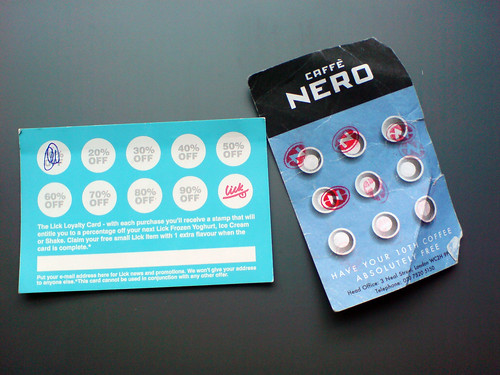
Offering just a future discount based on behaviour will fail. If you're going to use discounts, do it on initial purchases to try and build a habit. (let's not pretend it's loyalty, and rename it inertiamarketing??!)
Do something special on the first purchase, not the 100th
Look for ways to create prestige and recognition rather than discounting the brand
Change the way the brand behaves with people who are interested. I've said it before, but for me the best 'loyalty schemes' are those that crowd-source and ask for opinions that will be acted on. P&G Tremor, Nokia, BMW, and Lego are all good examples.
If you use points and prizes, then make sure you link it to a data and insight strategy that allows you to understand people better and test different propositions, offers and ideas with them.
If you're online - make registering have no barriers to entry so you can immediately start to buld up a picture of what people are looking at and buying (and link into a data & insight strategy as above). This means something special on the first purchase (or even browse) not the 100th. Oh, I've said that already.
And have a bloody good product or service. (quite important that one)
Probably the silliest thing to do right now is to open a record shop. A shift to downloads and even the big boys are struggling.
But John and Elaine have gone and done just that in East Dulwich (which was missing some musical-like shopping opportunities). Hurrah!
They're running the shop as an open community collective - encouraging anyone and everyone to come on, get involved, help out and generally spark off a music community. I spent a good few hours today, pricing up records and trying to put together shelves for them (badly, I must add).
Who knows if they're mad or inspired. But if enough people get involved, there's a fighting chance that the Dream Machine (sister store in Texas) can survive and thrive.
I'm going to be helping them out, trying to think of new and cool ways to spark off some word of mouth, get people involved, and hopefully enable lots of local music-loving folk get their fix.
Launch part is tomorrow at the Constitutional Hall in East Dulwich. Here's the details on the East Dulwich Forum
Juis Suis Animal and Martin Carr (of Boo Radleys fame) are playing. Come on down - it's only £6.
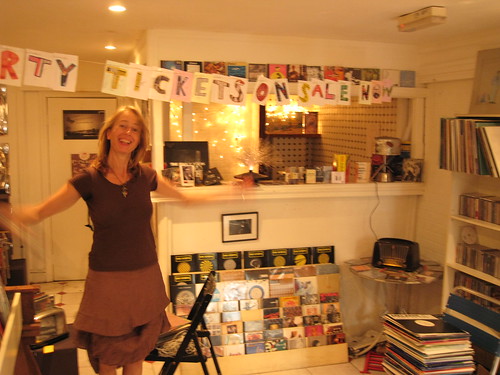
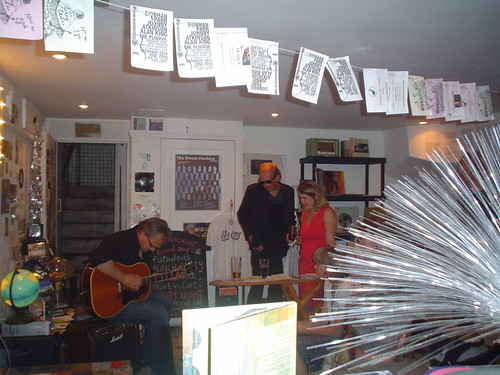
And here's the party in the shop last night... probably be another one tomorrow night!
It seems the link wasn't working on my last post, so here we are embedded. If you haven't read the previous post, this is a sabotaged version of the Orange 'I am' TV ad. With changed dialogue and music....
Creepily telling us that mobile phone operators are collecting lots of data and spying on us.
I think there's a really good central thought here - something to do with mobiles connecting and enabling your life - past, present and future. Certainly a brave attempt to position Orange as more important than a particular tariff or offer on a new phone.
But I find it a bit dark and a tiny bit creepy.
It might be the music (slightly melancholy piano number, that reminds me of a cross between Four Tet and Boards of Canada).
Or perhaps it's the way people fade in and out like a dream / nightmare.
Maybe it's the way no-one seems to smile properly. (Even the 'encouraging' teacher, has an evil glint in her eyes).
It actually makes me feel that David Lynch might have been involved, and the narrator / viewer is actually a psychopathic serial killer living in a distopian world.
Good to see that it's spawned some rip-offs already. Check out this reworked version: 'Agent Orange'.
Suddenly the original doesn't seem quite so disturbing.
31st May. Boris stops people drinking on public transport in London. So no surprises that there's a big party - centred on the circle line. Lots of drunken behaviour, vomiting and a number of arrests in this alcohol fuelled flash mob.
For me, echoes of the Paris Commune and the student uprisings of the 1960s. People trying to lay claim on a public space and redefine what different boundaries stand for. In this case, we're seeing a protest / class struggle / dispute over both physical and social boundaries, with the resistance coming in a playful manner (reminiscent of the Situationist International).
A few years ago, we would have marvelled how this was organised through social networks and mobile phones. (But though those of us who went to raves in the 80s/90s know that you don't need digital technology to organise some unlicensed fun.)
Interestingly, (if you follow Mark Earls and his Herd theory) this circle line party wasn't some centrally-controlled and organised event. There weren't some 'key influencers' who told everyone else what to do.
It actually came about from many different groups and people debating about the change in the law and thinking it would be a good idea to commemorate the occasion in the best way we know - a massive piss up. And the circle line pub crawl has been a student favourite for generations.
So the perfect conditions for an idea to be spread / imitated through people's behaviour:
* lots of different groups all with similar beliefs * a highly dispersed network, with many 'weak links' that allowed these different groups to hear about what others were planning * and yes, I suppose, the technology to make it easy for these weak links to be connected and for the idea to be spread * an incredibly visible action that is easy to imitate
Lots of people drank far too much, and I'm sure there were many sore heads the next day. But I wonder how much more people drank because they got caught up in the occasion? Many would have gone with the intention of drinking as much as possible. And there were enough of these to get a critical mass of people behaving in one way. Through imitation and subconsiously wanting to fit in, many more will have changed their behaviour away from what they rationally would have intended.
It's like a night after work. You go out with no intention of staying out too long. If there are one or two people wanting to carry on, that's not enough to make you stay. No matter how influential they are. But if there are a few more, and the night is more interesting / entertaining that you expected, you stay out. When you see someone who's not normally out having a few, it makes you feel better about staying out yourself.
So I was particularly interested to read this month's Brand Strategy, where Pamela Bower-Nye, global marketing director for attitudes to alcohol at Diageo talks about their responsible drinking strategy.
She talks about the need to move away from lecturing about responsible drinking to talking about 'choices'. Reading what she says, the focus of Diageo's campaign is on making the consequences of irresponsible drinking personal - being excluded by their social peers for being an embarrassment. (Making people think about personal consequences is also the strategy behind Leo Burnett's drink and drive ad campaign).
However, I think for these campaigns to work, its not enough to give people a message when they're sitting in their living rooms - no matter how personal / relevant / engaging the message might seem.
It requires brand action alongside brand message. This means doing something at the moment of choice - i.e. at a night out - something that actually changes people's behaviour at that moment, so that others imitate.
I'm working on a pitch just now where one of the questions is 'what is the future of loyalty programmes?'
When I started in this industry loyalty schemes were new and exciting and would save the world from bad advertising. Now they're increasingly commoditised and people now expect rewards on initial purchases in the form of cash-backs on sites such as ipoints or quidco. So where's all the loyalty gone?
So here's my quick and dirty predictions. Would love to hear other people's thoughts!
Consolidation into a few large points schemes where people can see the benefit from buying products and services across multiple sectors
Move from points into cash-back for these larger schemes (especially online aggregator schemes)
Successful loyalty schemes will be those that are aligned to a holistic customer data strategy that enables brands to understand and connect more with people at a personal level
Branded loyalty schemes will evolve to focus on enhanced experience of the brand’s product or service rather than discounted points converted into unrelated goods
I like music.
I like computers, technology and games.
I like geography, philosophy and psychology.
I sometimes like applying all this to the world of brands, organisations and people