Showing posts with label Planning. Show all posts

Friday, January 2, 2009

Asking for online feedback


Many sites (amazon, expedia, etc.) ask you for feedback when you buy something. ebay goes further by making it such an integral part of the process. By I received an email today from a US company called Zooscape.com that goes to a new level.

They've given me a list of reasons for why customer reviews are really helpful. I actually found the list quite interesting, and indeed helpful. I will be using it in presentations to clients - to show the value of opening out the brand to customer feedback, and also to show how a long form email can be a valuable part of CRM alongside offers.

Here's their list of reasons in full:

* Let me take a moment to explain why product reviews are so important.

We trust that your shopping experience with ZooScape.com was a positive one, and while we hope every product we sell offers a high level of satisfaction, we simply cannot be absolutely sure unless we get feedback from customers like you. We sell a lot of products, and we do our best to keep ourselves informed and provide you with as much specific information as we can. But, in the end, it is still YOUR experience that really counts and keeps us better informed about aspects of a product that would otherwise be unknown to us.

We take all the reviews we receive very seriously, good or bad. In fact, your reviews can even make or break a product at ZooScape.com! Here's how:

When people like you share their positive reviews with one another, more new visitors to our site can be confident in the satisfaction and results they will achieve. Your review may be that final little bit of information necessary to sway someone else into finding a product with life-changing results! Then, that person's positive experience is passed on and read by another person, and so on....

On the other hand, if a product is simply not 'living up to the hype', and is receiving lukewarm or even negative reviews, then inquiring shoppers have the right to know. In fact, if the growing body of public opinion is that a product is simply ineffective, we will remove the product, (not the reviews), from our site! Honestly, there are some products we no longer sell because the reviews were awful.

With the staggering number of products available online, getting the benefits of previous users' experience is vital. I am also a shopper, of course, and I also buy products online. I personally find that reviews act as a safeguard ensuring quality and efficacy of every product. Like everyone, I am much more confident buying a product online if I have seen reviews for it first.

Think how you feel when you come across a product that you think might be right for you, and some great reviews or a few success stories confirm those very thoughts, providing you with confidence and certainty. Think of how you feel when a review might make you aware of something you neglected to consider about a product or its claims, steering you in a better direction. A community of people sharing thoughts, opinions, and experiences is an extremely beneficial process in the online shopping world.

Of course, not everyone is in 100% agreement, and experience with the same products may vary. But, a longer list of reviews for any given product means a more accurate general consensus. It takes just one person with the courage and dedication to write one simple product review to 'get the ball rolling'. That's how online communities and forums are created!

We would greatly appreciate your thoughts and opinions on any ZooScape.com products that you have purchased, or even a product that you purchased elsewhere, but would like to express a few thoughts about.

We are giving you, the customer, a forum to be heard by thousands of people! If you wish, you can even state your opinions with the comfort of knowing that you are protected by total anonymity by entering your name in the review as 'anonymous'.

So, this is why I am personally asking you for your help. On behalf of all present and future ZooScape customers, just like yourself, I know that the more product reviews we have at our site, the better informed everyone is going to be.

Saturday, November 22, 2008

The voices in my head


So yesterday, after 18 action-packed months, I left Proximity London.

(I'm joining iris in a group head of planning role.)

But I thought I'd do a top five personal achievements at proximity for my own records. Yes, a bit narcissistic, but that'll be blogging in general.... And there's nowhere else to put it.

1. Delivering digital strategies for RNLI and Harveys for 2009 (let's hope they're implemented), and winning a place on Shell's global digital roster

2. Seeing Harveys become a genuine challenger brand to DFS following the sponsorship of coronation street. It shows how a simple strategy, good advertising and a passionate client and agency teams can really make things happen. I think the most satisfying was seeing new work across multiple channels - TV, Print, Leaflets, Website, Email, Mobile, In store.....

3. Working with DDB and Mediacom on VW annual planning. The BTL agency wouldn't normally have had that level of involvement, so we (proximity) were very pleased. Some lovely campaigns for VW: Scirocco, Golf v6 (to come), Tiguan, Touran, Passat CC too.

4. Mentoring or helping or working with some great people who I know will do well - james hidden, james hough, jamie chadwick, kirtsy higgins, abi fletcher, mat spencer, jo dann, andy ford, emma bushnell, charlie h-s, nicole mackintosh, andrew waddell, matt tanter, scott hendry, anna booth, megan randell, emma slade, tessa clements.

5. Actually using semiotics, ethnographic research and discourse analysis sensibly and practically for some work! Simon W - the original map of possible positive charge inputs seems to be working....


Thanks to amanda phillips, mark hancock and kevin allen who took a bit of gamble letting me in the building in the first place. Thanks proximity and good luck in the future.

Monday, October 13, 2008

Planning to get talked about


It's see something that:

a) uses direct mail effectively - interesting stuff was sent to a number of young video bloggers

a) uses social media effectively - they were encouraged to open their mail on their vblogs.

c) has a bigger and wider social meaning - they were asked to produce content that flies in the face of the media stereotypes of young people as knife-holding hoodies and shows the youth of Britain as a more caring, involved and socially active group of people.

d) has a real world social element of people doing things together- the bloggers were invited to the RNLI head quarters in Poole to see what they do and meet young people who are contravening the youth stereotypes by volunteering as crew or as lifeguards. The bloggers blogged about this too.


so from less than 20 mail-packs to over a quarter of million views, responses, texts, emails showing that the previously silent majority of british youth are now prepared to speak out.

watch out for the next phase. 'Broken Britain' ((c) The Sun, 2008) is going to be fixed.....

Check out all the mystery package videos and responses on You Tube.

A genuinely positive action from an organisation that is trying to connect people using the most cultural relevant means available.

Sunday, July 27, 2008

We heart loyalty


(photo thanks to hummingbird heart on flickr)

When there's a sign of an economic downturn, many brands start to think about the old adage that it's more profitable to look after and grow value from current customers rather than to try and get new ones. I suspect this is because they're worried about losing customers to competitors who slash their prices in tough times.

Of course, trying to start 'loyalty' initiatives now is just too late.

For me, genuine loyalty comes down to one simple statement:

'Staying with something for the long-term even though there may be more attractive options available right now'.

So this means sticking with something even through 'bad times'.

Is this really possible? Will people really give a s**t about brands over the long-term? Can 'loyalty marketing really work?

The trouble is that most people discount the future. They are easily and irrationally attracted to offers. Tell someone you'll give them £10 now or £100 in a year, and most will take the £10. Tell them somethings free, and they'll overlook something much better that costs them only a nominal value. (Read the brilliant book 'Predictably Irrational' by Dan Ariely for more insight into this sort of human behaviour)

The other day, my parents booked a flight to the US, just so they had enough miles to maintain their American Airlines Platinum status. So I guess it can work.

But from this is a clue. Loyalty is more likely to come from experience over and above the norm (in this case not from privilege not points).

So what does that mean for brand wanting to get somewhere close to loyalty from customers?

  • Offering just a future discount based on behaviour will fail. If you're going to use discounts, do it on initial purchases to try and build a habit. (let's not pretend it's loyalty, and rename it inertia marketing??!)
  • Do something special on the first purchase, not the 100th
  • Look for ways to create prestige and recognition rather than discounting the brand
  • Change the way the brand behaves with people who are interested. I've said it before, but for me the best 'loyalty schemes' are those that crowd-source and ask for opinions that will be acted on. P&G Tremor, Nokia, BMW, and Lego are all good examples.
  • If you use points and prizes, then make sure you link it to a data and insight strategy that allows you to understand people better and test different propositions, offers and ideas with them.
  • If you're online - make registering have no barriers to entry so you can immediately start to buld up a picture of what people are looking at and buying (and link into a data & insight strategy as above). This means something special on the first purchase (or even browse) not the 100th. Oh, I've said that already.
  • And have a bloody good product or service. (quite important that one)

Sunday, July 13, 2008

I am .... disturbed


New brand campaign from Orange from Fallon.

I think there's a really good central thought here - something to do with mobiles connecting and enabling your life - past, present and future.  Certainly a brave attempt to position Orange as more important than a particular tariff or offer on a new phone.

But I find it a bit dark and a tiny bit creepy.  

It might be the music (slightly melancholy piano number, that reminds me of a cross between Four Tet and Boards of Canada).  

Or perhaps it's the way people fade in and out like a dream / nightmare.

Maybe it's the way no-one seems to smile properly.  (Even the 'encouraging' teacher, has an evil glint in her eyes).

It actually makes me feel that David Lynch might have been involved, and the narrator / viewer is actually a psychopathic serial killer living in a distopian world.

Good to see that it's spawned some rip-offs already. Check out this reworked version:  'Agent Orange'.

Suddenly the original doesn't seem quite so disturbing.

Tuesday, July 8, 2008

I drink, you drink, we drink


31st May. Boris stops people drinking on public transport in London. So no surprises that there's a big party - centred on the circle line. Lots of drunken behaviour, vomiting and a number of arrests in this alcohol fuelled flash mob.

For me, echoes of the Paris Commune and the student uprisings of the 1960s. People trying to lay claim on a public space and redefine what different boundaries stand for. In this case, we're seeing a protest / class struggle / dispute over both physical and social boundaries, with the resistance coming in a playful manner (reminiscent of the Situationist International).

A few years ago, we would have marvelled how this was organised through social networks and mobile phones. (But though those of us who went to raves in the 80s/90s know that you don't need digital technology to organise some unlicensed fun.)

Interestingly, (if you follow Mark Earls and his Herd theory) this circle line party wasn't some centrally-controlled and organised event. There weren't some 'key influencers' who told everyone else what to do.

It actually came about from many different groups and people debating about the change in the law and thinking it would be a good idea to commemorate the occasion in the best way we know - a massive piss up. And the circle line pub crawl has been a student favourite for generations.

So the perfect conditions for an idea to be spread / imitated through people's behaviour:

* lots of different groups all with similar beliefs
* a highly dispersed network, with many 'weak links' that allowed these different groups to hear about what others were planning
* and yes, I suppose, the technology to make it easy for these weak links to be connected and for the idea to be spread
* an incredibly visible action that is easy to imitate

Lots of people drank far too much, and I'm sure there were many sore heads the next day. But I wonder how much more people drank because they got caught up in the occasion? Many would have gone with the intention of drinking as much as possible. And there were enough of these to get a critical mass of people behaving in one way. Through imitation and subconsiously wanting to fit in, many more will have changed their behaviour away from what they rationally would have intended.

It's like a night after work. You go out with no intention of staying out too long. If there are one or two people wanting to carry on, that's not enough to make you stay. No matter how influential they are. But if there are a few more, and the night is more interesting / entertaining that you expected, you stay out. When you see someone who's not normally out having a few, it makes you feel better about staying out yourself.

So I was particularly interested to read this month's Brand Strategy, where Pamela Bower-Nye, global marketing director for attitudes to alcohol at Diageo talks about their responsible drinking strategy.

She talks about the need to move away from lecturing about responsible drinking to talking about 'choices'. Reading what she says, the focus of Diageo's campaign is on making the consequences of irresponsible drinking personal - being excluded by their social peers for being an embarrassment. (Making people think about personal consequences is also the strategy behind Leo Burnett's drink and drive ad campaign).

However, I think for these campaigns to work, its not enough to give people a message when they're sitting in their living rooms - no matter how personal / relevant / engaging the message might seem.

It requires brand action alongside brand message. This means doing something at the moment of choice - i.e. at a night out - something that actually changes people's behaviour at that moment, so that others imitate.

Tuesday, June 24, 2008

Is there a future in loyalty?


(photo thanks to atomicshed on flickr)

I'm working on a pitch just now where one of the questions is 'what is the future of loyalty programmes?'

When I started in this industry loyalty schemes were new and exciting and would save the world from bad advertising. Now they're increasingly commoditised and people now expect rewards on initial purchases in the form of cash-backs on sites such as ipoints or quidco. So where's all the loyalty gone?

So here's my quick and dirty predictions. Would love to hear other people's thoughts!

  • Consolidation into a few large points schemes where people can see the benefit from buying products and services across multiple sectors
  • Move from points into cash-back for these larger schemes (especially online aggregator schemes)
  • Successful loyalty schemes will be those that are aligned to a holistic customer data strategy that enables brands to understand and connect more with people at a personal level
  • Branded loyalty schemes will evolve to focus on enhanced experience of the brand’s product or service rather than discounted points converted into unrelated goods


Wednesday, June 18, 2008

Is ROI killing innovation?


Brent Hoberman (of lastminute.com fame) did the opening address at the Future of Digital Marketing 2008 conference today in London.

Presenting without PowerPoint, he took us on a lightening-fast and enlightening trek through his experiences, ideas and other random digital-related thoughts.

(It was a shame that the rest of the day couldn't live up to such a great opening... some of the presentations would have more appropriate at a 'past & current of digital marketing 2004' conference)

Brent knows he's been successful, but he wasn't arrogant enough to suggest he's an innovation genius. When talking about his newest innovation - mydeco.com - he was humble enough to suggest that there's still lots of learning to do. Some things that currently look like winning elements might not take off, and other simple ideas might end up being the killer app. Successful innovation comes from setting off lots of initiatives and ideas - not necessarily one 'big' idea.

So one thing Brent said really struck home - he questioned whether ROI can kill innovation. He wasn't saying that as marketers we shouldn't worry whether things are working or not - of course we should care about this. No, he was suggesting that the obsession with 'ROI' and 'certainty' will stop good and new ideas from happening.

How can you do something different and innovative if you need proof that it will work?

At worst this would mean only ever copying what you or your competitors have already done.

At best, proof can be 'found' by looking in different categories and piecing together 'evidence' from case studies that are similar to the strategy / idea that you're suggesting.

But history is written by the victorious. There are few case histories that demonstrate what hasn't worked. (Brand Failures by Matt Haig is the only real example I can think of). Looking within these 'case studies of success' from a source like the IPA Effectiveness Awards will quickly confuse you with success coming from apparently contradictory strategies for two different brands in the same category....

For me it comes down to the difference between efficiency and effectiveness.

Measurement and ROI analysis can only ever help you be more efficient. Spend your money again in places where it worked and take your marketing dollars out of stuff that doesn't. Good worthy stuff that we should all do. (Although I would argue that a red, amber, green model for 'should we do it again?' would simplify this process and prevent us having to wade through graph after graph of data analysis)

Improved effectiveness will only come from innovation. Doing something different to the category, different to the norm and providing some genuine value to the people you want to buy your product or service. Yes, measurement and ROI analysis can be one of the inputs into the innovation and ideation process, but 'proof' can never be found to justify something genuinely new.

So it worries me that whilst 2007 saw many agencies and businesses invest in innovation departments, job titles and descriptions, the current 2008 climate is seeing our friend ROI turning up to every party, with his close friends 'guaranteed' & 'proof' tagging along.

It's a party with lots of conflicting and loud voices. I just hope everyone can get along and innovation isn't ushered out the back door for being too unreliable...

Wednesday, May 28, 2008

Trade on Trust


About a year ago, at my last agency, I pitched (unsuccessfully) for Royal Mail communications planning. The big idea that we had (thanks to Simon and Graeme) was for RM to transform their SME database into an active and living online community where other people (businesses or consumers) could rate and review SMEs. Rather than a static listing with just the address and web page, SMEs would be humanised.

(...the people behind the numbers, you might say!!!).

We called it 'Trade on Trust'.

It was a big idea, and perhaps too much of a stretch for Royal Mail at the time. But given recent experience with builders, trust is so important in choosing your hired help.

We needed some builders. We went on the East Dulwich Forum. There were quite a few recommendations, but 'Tom & Jay', stood out a mile for their glowing reports. We phoned them, got them in and got a quote. They were about 30% more expensive, and of course, we had to wait 8 weeks more to get them in. The rational brain said that they couldn't possibly be that much better. But then the emotion kicked in. This is the house we want to stay in for years, we really want it to be perfect.

And of course, the emotions won, and we're now living in a tip as Tom and Jay (& Dirk) are at work. As with any building project, the costs already seem to be spiralling.... 'No, that wasn't quoted for.' ... 'actually this would look a lot better with a new wood flooring...'. Hmmm.

And yet, even though I rationally know that we might be being overpriced, the thought of getting another builder / carpenter etc. in for these additional jobs, seems like a bit too much effort. (Which I'm sure is what Tom & Jerry, sorry Jay, are expecting.) But if this was a scam, surely the East Dulwich Forum would have some luke-warm reviews?

I've always suspected that the only reviews written are those that are either really positive or those that are really negative. And who wants to say on a review that they think they might have been ripped off? Particularly when they look at their finished masterpiece and they're filled with emotional pride. (And I have to admit that T&J are doing an excellent job).

Perhaps we have artifically inflated reviews akin to the Hawthorne Effect?

So how can people like me get a 'real' sense of who to trust for projects like this?

Can businesses really 'trade on trust'?

I am sure that there is still an opportunity waiting to be grabbed by a business that has both national scale and local relevance. (Royal Mail / Post Office, Yell, Thomson, Trinity Mirror, BBC, ITV, Job Centre Plus....) But to make it a success, this online resource /portal would need to have a pretty complex recommendation algorithm. Not just an 'average'. An algorithm that measures recency, importance, semantics, context, validity & volatility.

So maybe we'll have to leave it to Google then.

Sunday, April 27, 2008

Fast Strategy


Tomorrow (28th April) is the IPA Strategy's conference: 'Fast Strategy'.

I'm pleased to say that by being part of the IPA Strategy Group, I've had a small part to play in helping get this show off the ground.

It promises to be a lot of fun. We've got three teams (leaders are Mark Earls, Phil Georgiadis and Johnny Hornby). They're taking a COI brief in the morning, to come back with their strategies in the afternoon. In the meantime, the conference attendees can listen to some thoughts and ideas from the great and the good of ad-land, with TBWA, Wiedens, Grand Union, the Times, Naked, and Leo Burnetts all doing a turn.

At £150 a pop, it's actually pretty good value for a day of good speakers. But I know I've not found it easy signing this off (yes even group members have to pay... the IPA aren't going to miss out on any possible income!).

So I hope the attendance is good, the speakers are great and people enjoy the fun and frivolities.

My money's on Mark E's team to crack the COI brief... not sure if anyone's actually running a book though???

What this space for a (not so impartial) review.

Sunday, April 13, 2008

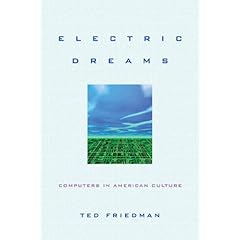
Electric Dreams (Book Review)

History isn't always written by the winners.


Usually, books with a historical theme have a habit of being quite dull.

Often these books are revisionist texts drawing on multiple references to build a single argument: references the author agrees with and references that they feel they can shoot down.

Or alternatively, the author tries to cover every possible aspect, view and detail that the reader gets bogged down in tedium. (See Peter Ackroyd's books on London and the Thames for a good example of detail obsession)

This book didn't look too promising at first glance:

* it is about 'computers' - I really didn't want to read about the development of fortran and cobal
* it is about computers in 'American' culture - I'm generally very sceptical of American-focused stuff
* there didn't appear to be too many pictures

But I loved this book.

Computers represent the ultimate dialectic of capitalism. They represent power and control, yet they also represent liberation and grass roots activism. Individualism and collectivism. Technology allows for the concentration of the means of production in the hand of the few (think of the use of computers in the City), yet also allows people to connect and share ideas that undermine the very fabric of capitalism. (think terrorist operations and the dispersed yet effective organisation of anti-capitalist action).

This book is wonderful, not only in that it got me thinking about a whole host of dialectic observations (!), but primarily because of how it considers its topic:

It's a cultural reading. Rather than reviewing academic texts or considering primary and secondary sources of consumer research, the author looks at how 'cultural texts' are produced within and without the system. He considers the way in which these texts demonstrate how computers affect and are affected in American culture

What does that mean in English?!!

Well Ted Friedman (the author) has a look at a bunch of letters, films, magazines, games, TV programmes, adverts, websites to see how computers and stories / mythologies surrounding computers' roles are represented.

So we get a look at the films 'the Desk Set', '2001', 'Matrix'. We look at Wired & the Wall Street Journal. We look at Apple's 1984 ad and IBM communications. We look at cyberpunk literature (eg. William Gibson and Kurt Vonneget. We look at Civilisation and Sim City as 'God' games. We look at flash mobs and blogs.

It's a very diverse and informative read, picking up and picking apart multiple threads. (Although it can be a little heavy going in places). Moreover, it takes a potentially turgid topic and litters it with interest.

What's particularly refreshing, is he tries to consider diametrically opposite views (i.e. technology as a good thing vs. technology as a bad thing). And by considering texts produced at a point in time (historical materialism), he avoid too much revisionist thinking.

It reminded me of Convergence Culture by Henry Jenkins (another very excellent book). Jenkins also looks at culture to consider changes in the world of media and entertainment. (His texts being The Matrix, American Idol, Star Wars, and Harry Potter amongst others)

Actually, check out Jenkins' blog
if you have a spare few hours (pithy, he is not)

But anyway, back to Electric Dreams...

There is no central argument per se, although Friedman is certainly of the view that technology is a great liberator rather than something that should be suppressed and controlled. He is in the optimism camp, where all possible worlds should be dreamed and imagined and can be fulfilled by technology. The language he uses gives him away as someone who has been trained in Marxist ideology and one who believes in a lot of it.

But hell, this blog isn't called commune for nothing...

Tuesday, February 19, 2008

WH Smith in 'great experience' shock


The other day I was at Paddington station and needed to buy a card. (yep for valentines!)

So I picked up a card in Smiths and went to the queue. It was ten people long and I had 5 minutes to get to my train. Decision time - do I stay or do i go?

Just as I was about to leave I heard one of the four cashiers yelling:

'come on, come on. keep it up. these people have trains to catch. keep it moving, keep it moving'.

And all of the other cashiers were smiling, and I was rapidly moving towards the front of the queue. They were even tossing bags of change to each other to deal with the inconsiderate commuters who had obviously just got a twenty out at the station.

Amazing.

I was reminded of the the old training video from video arts 'Fish' which was designed to show people that even the most mundance jobs could be good if you injected a bit of fun, energy and team spirit.

Tuesday, October 9, 2007

Shameless Plug


Been having a lot of fun over the last few months with Harveys and itv / Coronation Street - with the big launch of the new sponsorship idents last week.

Check out the Corrie content on the website too that we've done - and play the Rovers Pub quiz that we've put together with the excellent Player Three.

It seems that every half decent TV programme has a sponsor these days, and I have to say that so many idents seem to be half baked ideas with little or no relevance to the programme they're sponsoring.

Corrie is one of the only programmes that consistently pulls a large mainstream audience, and Harveys could easily have been lazy, viewing the deal as 'cheap' airtime and settling for a cheap and nasty ad. But I think they've been brave by investing in CGI ads, online gaming, interactive and mobile internet to leverage the sponsorship with a long term strategy to help make Harveys stand out from the glut of me-too furniture retailers lurking near a out-of-town centre near you.

Harveys will have to ensure that the product and service are up to the right standards to ensure that people who try them for the first time are left satisfied. And that means in the store, waiting for delivery, the actual delivery and after-sales queries. Unfortunately, all the clever advertising in the world won't overcome negative reviews and word of mouth, which has been a problem for them in the past.

The right sponsorship deal has the power to change businesses - not just in terms of higher awareness, intrigue and google searches - but as a platform to consider and sort out every way in which the company and brand can and should add value to the customer experience.

Saturday, May 12, 2007

Agency see agency do


Maybe I'm just more aware after my trip. Or maybe there really is something rippling through agency world. Once again, Soviet iconography has popped up - this time on Sky Sports' TV ads.

By my reckoning that's four major advertisers (Sky, Pizza Hut, Virgin and Ask) who are trying to spark off community revolutions of one sort or another.

It seems that Herd theory works for agency folk too.

Or maybe it's actually all those planners who have read the Herd book / blog and are now subliminally writing their creative briefs with collectivism in mind - sparking Soviet images in the creatives' minds?

Either way: Vivre la commune!

(Apologies & thanks for the shameless rip off of Faris' line from his recent excellent post on behavioural engineering for this blog post title)

Wednesday, April 18, 2007

Privyet Comrade!

So I've been to St. Petersburg in the last week and been very impressed with how much the USSR loved the old 6 sheet and obviously had some good copywriters. Some classics:

'Vodka is your enemy. Your passbook is your friend'
;

or 'Let's have the proletarian parks of culture and rest';

or my personal favourite:

'Smoking is expensive and dangerous for health and work'. (Who needs Nick O Teen?)

And now I'm incredibly aware of a bit of an onslaught of Russian Iconography and sloganeering in some recent advertising ideas.

Pizza Hut came out recently with their 'Seize Your Lunchtime' campaign. (I won't call it an idea ... lazy, lazy planning with no real insight, I'm afraid)

And probably more in tune with a call for a popularist uprising is Ask with their Information Revolution / Anti Google campaign. Greg has commented on this elsewhere, and I agree with his views that the execution could have been less corporate, especially on the website.

However, (unlike Pizza Hut) this feels like an idea that might actually be connected with a genuine insight - that some people have concerns about the ubiquity of Google, have a desire to be different, and are looking for an 'underground' movement to be part of. I'm looking forward to seeing if the campaign is working and how it will develop.

The challenge for Ask is that (as I've commented before elsewhere) the Internet is as close to the proles seizing the means of production anyway, and Google are at the forefront of giving the power to the people already.

My worry is that Ask will see a spike in traffic, but with a lack of genuinely different & innovative new products, those defectors will rapidly go back to the not-too-evil-ones.

Monday, March 12, 2007

Weak Links


Just picked up a(nother) new report from the US on WOM. Check it out and download here.

I picked up this comment on the report from Dani Marino, who talks about a concept called Social Persuaders and Influencers or SPIs. SPIs are people with large, active and many social networks. They have persuasive power and they love to talk about products and services. And they are 10% of the market...

As with a lot of stuff on WOM, there does seem to be an obsession with finding those important broadcasting types. Or social connectors as Gladwell calls them.

Find them, seed your message into and across their social networks and watch the dollars roll in. That'll be WOM wrapped up. Bring on the YouTube, Myspace, Tribe, MOG, Rateitall and Faceparty seeding campaigns with clever and humourous content! 7% positive buzz and 1% growth or so the LSE tell me.

But it seems to me, that people forget a few key things:
  • Messages at best travel in a superficial way - instantly consumed and disposed of. ideas on the other hand have a chance of sticking - although they will probably be re-appropriated and become out of the control of the initial originator
  • And as a proper reading of network theory will tell you (including the tipping point): For stuff to travel the receivers in the network / community have to be receptive. it is not enough to have loads of SPIs / broadcasters (or whatever we call them) chatting. People have to listen and want to take on or act on a dissipated idea. For an idea to travel through communities knowledge of the way in which information is exchanged within those communities is critical for success.
To have a chance of planning for an idea to spread socially requires a deeper understanding of linguistics, semiotics and ritual - within and across different communities.

It means understanding the weak links in a community and across communities as well as the so-called strong links of the SPIs / broadcasters (that everyone else is probably bombarding with rubbish viral messages anyway)

This Blog is not taking place


It seems that the spectacle of this blog is already much more important than the reality of it....

People have been talking about it for a while. I've been talking about it for, oh, nearly a year.

And now, as it goes through a difficult birth (and premature - thanks Doug), it's already undergone a few christenings, changes of clothes and is having a pre-school identity crisis - defined by the spectacle of what others think it ought to be, before it has uttered it's first few words to become a reality.

So why these mixed metaphors? Well, I read with great sadness at the passing away of one my heroes last week - Jean Baudrillard. Controversial in his writing, he is perhaps most infamously known for his writings on the first Gulf War (it won't take place, it is not taking place, it did not take place) and essays on the twin towers 9/11, where he described the horrors as 'a fusion of history, symbolism and dark fantasy - the mother of all events'.

I'm not going to deconstruct his arguments, primarily as they have been examined beforehand by excellent scholars more qualified than I. However it seems strange to me that I picked up the 'Gulf War did not take place' only a few weeks ago, and he then goes and dies.

I had decided to re-read this book, not because of a particular interest in the Gulf War, but because recent thought on brands (e.g. Grant's view on brands as molecules of real, authentic ideas) seemingly goes against Baudrillard's central thought that the spectacle (i.e. people's perceptions, influenced by media commentary) is becoming more important than the reality (i.e. what is really going on).

[Ok - Baudrillard's argument on the Gulf War, was that it was entirely constructed through the media for the purposes of both the West and Sadaam; the 'war' was won before it started and did not involve proper conflict - so how could it be called a war?; and it took place mainly on CNN rather than in the Gulf]

So, in our 21st century, Internet-dominant, convergent world, Baudrillard is surely wrong. We are no longer at the mercy of what the behemoth media companies want to tell us about the world as spectacle. We can check out real-time live feeds and blogs for the 'reality' - as we have seen in blogs from the front line for the Iraqi 'war'.

But as Henry Jenkins has succinctly argued, our culture is necessarily an interplay between the large media players and those who wish to participate. And listening to Al Gore on the radio this morning, Current TV, (for all of it's 'democratic' intentions of participatory culture and user generated content), has a 'review panel' of people who decide what is interesting / acceptable for popular consumption. Democratic??

However, surely the best measure of what is interesting / acceptable / influential / authoritative on the Internet and in the blogosphere is the number of links / downloads and views. In other words, popularity.

Does popularity mean reality and truth???!

I think it is dangerous to be swept away by the fantasy that the democratization of the Internet has opened up reality for everyone and swept spectacle under the carpet.

The spectacle has pulled off its greatest trick (again) by convincing the world that it doesn't exist.

I hope Jean is smiling.